The short version
- Most business agents (customer service, document processing, internal assistants) are not high risk; your duties today are AI literacy under Article 4 and, for anything that talks to people, the Article 50 disclosure.
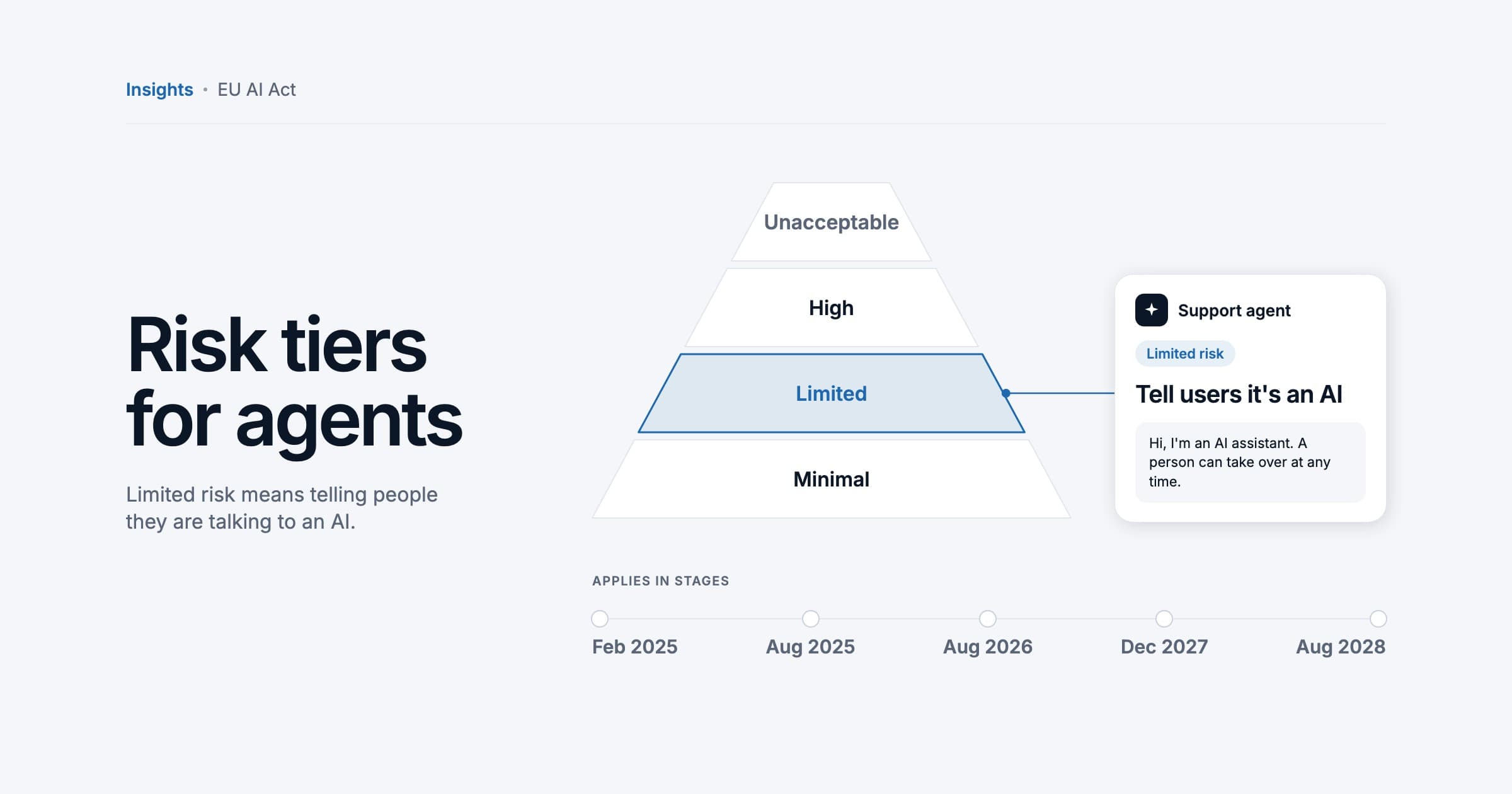
- Article 50 transparency has applied since 2 August 2026: a chatbot or voice agent must tell people they are dealing with AI, at the latest at the first interaction.
- The Digital Omnibus on AI, Regulation (EU) 2026/1744, is adopted and in force since 27 July 2026: high-risk duties for HR, credit scoring and other Annex III uses now apply from 2 December 2027.
- Agents that screen CVs, rank candidates or evaluate staff are high risk under Annex III, and emotion recognition at work has been banned since February 2025.
- The AI Act sits on top of the GDPR, not instead of it: you still need a legal basis, a processor contract and, for HR or scoring use, usually a DPIA.
General information, not legal or tax advice. Laws and deadlines change: check the sources and ask your lawyer or tax adviser before you act.
If your company uses AI agents or chatbots built on someone else's model, the EU AI Act treats you mainly as a deployer. For typical business agents, two duties already apply today: AI literacy for the people who use them (Article 4, since 2 February 2025) and, for anything that talks to customers or staff, a clear disclosure that they are dealing with AI (Article 50, since 2 August 2026). Agents used in recruitment, staff evaluation or credit scoring are high risk, but those duties were postponed by the Digital Omnibus and now start on 2 December 2027.
This guide is written for owners, COOs and heads of IT who are rolling out agents, not training models. It covers which role you hold, where common agents fall, what changed in July 2026, and what to document before your first agent goes live.
Provider or deployer: which one you are
The AI Act assigns duties by role. A provider develops an AI system, or has one developed, and places it on the market or puts it into service under its own name (Article 3(3)). A deployer uses an AI system under its authority in a professional context (Article 3(4)). The model vendor is the provider of the general-purpose model; the duties for those models have applied since 2 August 2025 and do not fall on you.
The grey zone is the agent itself. If you buy a finished product, such as a helpdesk tool with a built-in assistant, you are its deployer. If you or an agency build an agent on a model API and run it under your own brand, you are usually the provider of that AI system as well as its deployer. For a customer-facing chatbot this matters little in practice, because the disclosure duty falls on whoever builds the system, and that is you either way.
The risk categories, and where typical business agents fall
The Act has no special category for agents. What counts is the purpose an agent is used for, not whether it chats, calls tools or acts on its own. There are four tiers: prohibited practices (Article 5), high-risk systems (Article 6 with Annexes I and III), systems with transparency duties (Article 50) and everything else, which carries only the general AI literacy duty.
| Agent or use case | Typical classification | What it means for you |
|---|---|---|
| Customer service chatbot or voice agent | Transparency (Article 50) | Disclose AI at the first interaction; AI literacy for the team running it |
| Document processing: invoices, contracts, claims intake | Minimal risk | AI literacy; GDPR as usual |
| Internal knowledge assistant or copilot | Minimal risk | AI literacy; access rights and data protection |
| CV screening, candidate ranking, targeted job ads | High risk (Annex III, point 4(a)) | Deployer duties under Article 26 from 2 December 2027 |
| Task allocation, performance monitoring or promotion decisions about staff | High risk (Annex III, point 4(b)) | As above, plus informing staff and works council |
| Creditworthiness of individuals; life and health insurance pricing | High risk (Annex III, points 5(b) and 5(c)) | Article 26 duties and a fundamental rights impact assessment |
| Emotion recognition of employees, for example in a call centre | Prohibited (Article 5(1)(f)) | Banned since 2 February 2025, apart from medical or safety reasons |
Two details catch people out. First, Article 6(3) lets some Annex III systems escape the high-risk label if they only perform a narrow procedural or preparatory task, but never when the system profiles natural persons, and ranking applicants is profiling. Second, fraud detection is expressly carved out of the credit-scoring category, so a payments agent that flags suspicious transactions is not high risk on that ground.
The timeline, and what the Digital Omnibus changed
On 19 November 2025 the European Commission proposed a Digital Omnibus on AI to simplify the AI Act and delay the high-risk rules, because harmonised standards were not ready. Parliament and Council reached a political agreement in May 2026 that replaced the Commission's flexible trigger with fixed dates. The text was adopted as Regulation (EU) 2026/1744, published in the Official Journal on 24 July 2026 and in force since 27 July 2026. It is law, not a proposal.
| Date | What applies | Status today |
|---|---|---|
| 2 February 2025 | Prohibited practices (Article 5) and AI literacy (Article 4) | In force; Article 4 reworded by the Omnibus |
| 2 August 2025 | Duties for general-purpose AI models, governance, penalties | In force |
| 2 August 2026 | Article 50 transparency; general application of the Act | In force; original high-risk date moved |
| 2 December 2026 | Machine-readable marking (Article 50(2)) for generative systems already on the market; new bans on nudification and abuse imagery | Coming |
| 2 August 2027 | Originally: high-risk systems in regulated products (Annex I) | Moved to 2 August 2028 |
| 2 December 2027 | High-risk systems under Annex III: HR, credit, education, essential services | New date set by the Omnibus |
| 2 August 2028 | High-risk systems in regulated products (Annex I) | New date set by the Omnibus |
What the Omnibus did not do matters as much. It did not touch the Article 50 transparency date, it did not remove any high-risk duty (it moved the dates), and it kept AI literacy as an obligation on providers and deployers, although in softer wording. Do not confuse it with the separate Digital Omnibus proposal that would amend the GDPR: at the time of writing that one is still in the legislative process, so plan on the GDPR as it stands.
Chatbot transparency under Article 50
Article 50(1) is the rule every customer-facing agent has to meet. It has applied since 2 August 2026, and fines for breaching it reach EUR 15 million or 3 percent of worldwide annual turnover, whichever is higher (for SMEs, whichever is lower) under Article 99(4).
Providers shall ensure that AI systems intended to interact directly with natural persons are designed and developed in such a way that the natural persons concerned are informed that they are interacting with an AI system, unless this is obvious from the point of view of a natural person who is reasonably well-informed, observant and circumspect, taking into account the circumstances and the context of use.
The Commission's guidelines on Article 50, adopted on 20 July 2026, make this concrete. The "obvious" exception is to be read narrowly, so do not rely on it. The notice must come at the latest at the first interaction, be built into the system's design, and be clear: a line hidden in the terms and conditions is not enough. Text, audio or visual formats are all acceptable, so a voice agent can say it at the start of the call. The system should also answer truthfully whenever someone asks if it is a bot, and in sensitive settings, such as health topics or vulnerable users, periodic reminders may be needed.
Article 50 has three further parts. Providers of generative systems must mark output as machine readable (50(2)). Deployers of emotion recognition or biometric categorisation must inform the people exposed (50(3)). Deployers who publish deepfakes, or AI-generated text meant to inform the public on matters of public interest without human editorial responsibility, must disclose that (50(4)). An agent that drafts customer replies a human then reviews and sends is generally outside 50(4), because that provision targets public-interest publications, but check the guidelines for your exact use.
AI literacy under Article 4
Article 4 has applied since 2 February 2025 to every provider and deployer, whatever the risk level. The Omnibus replaced the original duty to "ensure, to their best extent, a sufficient level of AI literacy" with a duty to support it, effective since 27 July 2026.
Providers and deployers of AI systems shall take measures to support the development of AI literacy of their staff and other persons dealing with the operation and use of AI systems on their behalf.
The new text adds that you are not required to guarantee any specific level of literacy for any individual. You still have to act. The Commission's AI literacy Q&A says there is no certificate requirement and no fixed format, that relying only on the vendor's instructions for use is generally not enough, and that an internal record of training and guidance is sensible. National authorities supervise this from August 2026, and the Act sets no fixed fine for Article 4 itself.
In practice, tailor it by role: a short session for everyone on what the agent does, where it fails and what must never go into it; deeper training for the people who configure it, review its output or handle escalations; and a named owner who keeps the material current when the agent changes.
High risk in HR: what deployers will owe from December 2027
Recruitment and workforce management are where most mid-sized companies meet the high-risk rules. Annex III, point 4 covers systems for recruitment or selection (including targeted job adverts, filtering applications and evaluating candidates) and systems that make or support decisions on promotion, termination, task allocation based on behaviour or personal traits, and performance monitoring. From 2 December 2027, deployers of such systems must meet Article 26:
- Use the system in line with the provider's instructions for use.
- Assign human oversight to people with the competence, training and authority to overrule it.
- Make sure input data you control is relevant and sufficiently representative for the purpose.
- Monitor operation, report serious incidents and risks to the provider and authority, and suspend use where needed.
- Keep the automatically generated logs for at least six months.
- Inform workers' representatives and affected employees before the system is put into service at the workplace.
- Tell candidates and employees that a high-risk system is used in decisions about them; Article 86 adds a right to an explanation.
In Germany the works council is involved anyway: introducing technical systems suited to monitoring employee behaviour or performance requires co-determination under section 87(1) no. 6 BetrVG. The extra time to 2027 is best used to pick vendors that will deliver the documentation you need, not to wait.
How the AI Act and the GDPR fit together
The AI Act regulates the system; the GDPR regulates the personal data flowing through it. An agent that reads customer emails, CVs or invoices with names on them is processing personal data, so all GDPR duties apply in parallel. The German data protection authorities set out their expectations in the DSK guidance on AI and data protection.
- Legal basis (Article 6 GDPR). The AI Act gives you none. Name one for each purpose, including any use of conversation logs to improve the agent.
- Processor contract and transfers (Articles 28 and 44 onwards). The model vendor and agent platform are usually processors. Sign a data processing agreement, check where data is stored and processed, and disable training on your data where the vendor offers that.
- Automated decisions (Article 22). Decisions with legal or similarly significant effects may not be based solely on automated processing without a specific exception. The Court of Justice held in SCHUFA (C-634/21) that a score can itself count as such a decision when it plays a determining role.
- DPIA (Article 35). Expect one for HR screening, scoring or large-scale monitoring. For high-risk systems, Article 26(9) tells you to use the provider's information for it, and a fundamental rights impact assessment under Article 27 can build on it.
- Transparency (Articles 13 and 14). Update privacy notices so they mention the agent, what it processes and who receives the data.
What to document, and a checklist for your first agent
Take a hypothetical company with 300 staff rolling out a customer service agent that answers order questions and drafts refunds for human approval. Its file does not need to be long, but it should exist before go-live and be updated whenever the agent's scope changes. An authority, an auditor or a works council will ask for the same things: what the system is, why you classified it as you did, and how people stay in control.
Before your first agent goes live
- Add the agent to an AI inventory: purpose, vendor and model, data it touches, owner, go-live date.
- Record your role (deployer, provider or both) and the risk classification with a short rationale, including why Article 5 and Annex III do not apply.
- Check the use case against the prohibited practices, especially emotion recognition at work.
- Write and test the Article 50 disclosure for every channel (chat, email, phone) and keep screenshots or call scripts as evidence.
- Make the agent answer truthfully when asked whether it is human, and give users a route to a person.
- Run role-based AI literacy measures and keep a record of who received what, and when.
- Sign the data processing agreement, document data location and transfers, and switch off vendor training on your data where possible.
- Decide on a GDPR legal basis, update privacy notices and assess whether a DPIA is required.
- Define human oversight: which actions need approval, spending or refund limits, and who can stop the agent.
- Keep logs of conversations and tool calls with a retention period that fits both the AI Act and the GDPR.
- Set up a process for incidents and complaints, and re-check the classification whenever the agent gets a new task.
How we can help
Bespoke IT designs and builds AI agents for companies in Germany, Austria and Switzerland, and we treat the AI Act and GDPR points above as design requirements from the first workshop. If you want a second pair of eyes on which processes are worth automating and how they would be classified, start with our free AI audit. For legal sign-off we will tell you when you need your lawyer or data protection officer.
Have a question about your own setup?
Ask our AI coworker. It answers in seconds and a person from our team follows up.

Bespoke One Coworker. AI assistant. Answers in seconds, estimate in three minutes.