The short version
- GDPR compliant AI needs four things: a data processing agreement under Article 28, processing in the EU or Germany, training switched off and a lawful basis for any US transfer.
- The EU-US Data Privacy Framework is still in force in October 2026, but an appeal is pending and the US Supreme Court's FTC ruling has weakened it, so keep standard contractual clauses as a fallback.
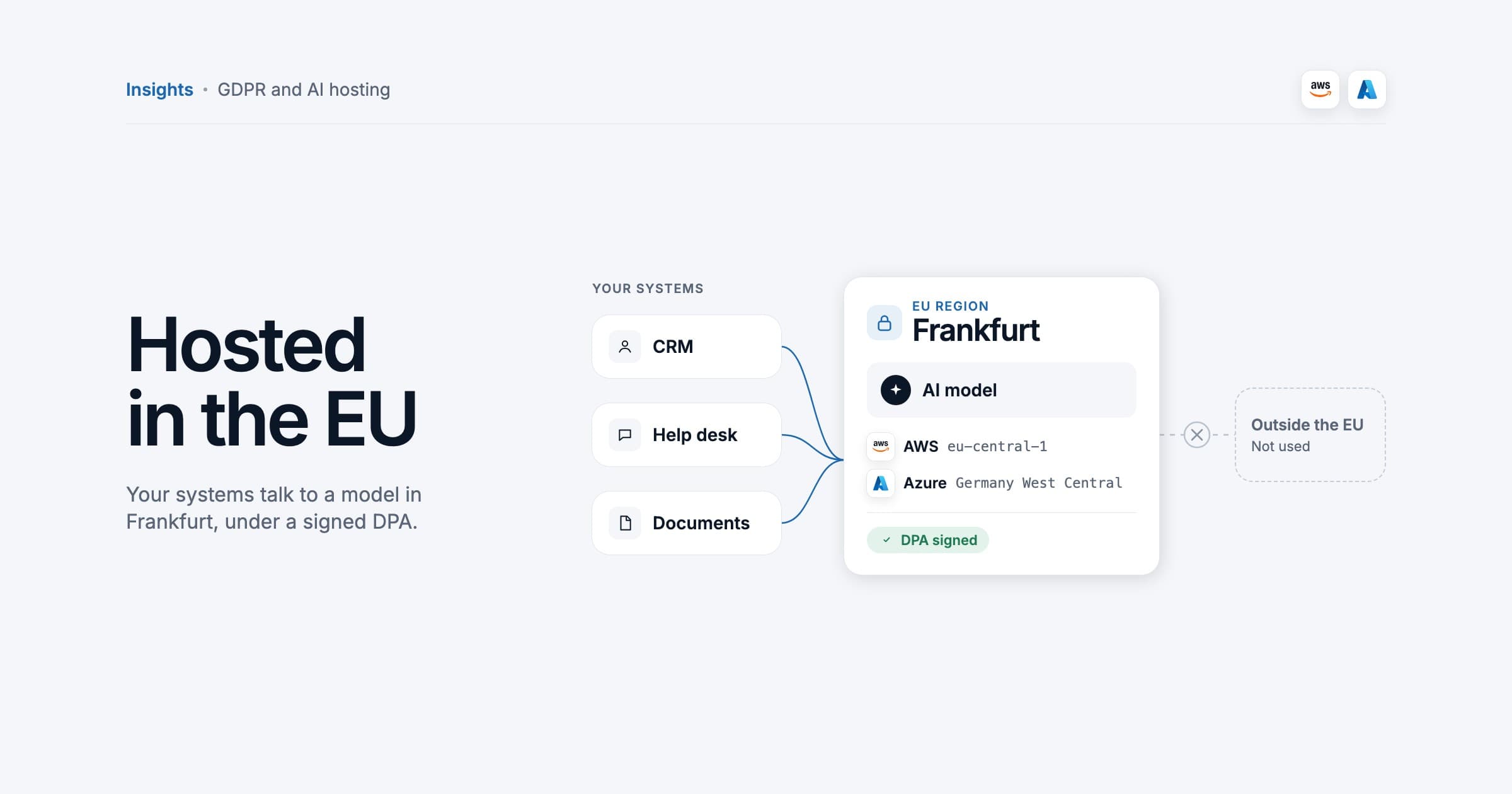
- Azure, AWS, Google and OpenAI offer EU processing; Anthropic's own API does not, so use Claude through Amazon Bedrock or Google Vertex AI in the EU.
- The German DSK prefers technically closed systems and expects a DPIA for many AI uses, including customer-facing chatbots.
- Retention is the most overlooked risk: provider safety logs, stored responses and your own traces all hold personal data.
General information, not legal or tax advice. Laws and deadlines change: check the sources and ask your lawyer or tax adviser before you act.
GDPR compliant AI is less about the model and more about the route your data takes. When an employee pastes a customer email into a chatbot, or an agent calls a model through an API, personal data goes to a provider that acts as your processor, is often stored for abuse monitoring for up to 30 days, and may be processed outside the EU unless you choose otherwise. To stay compliant you need four things: a data processing agreement under Article 28 GDPR, a deployment that processes data in the EU or Germany, training on your data switched off, and a lawful basis for any transfer to the US.
This guide reflects the position on 11 October 2026. Vendor options change every few months, so confirm each setting in your own contract and console.
Where your data goes when someone uses an AI model
A single prompt rarely makes one trip. Map these hops before you debate which model is best, because each one is a recipient, a storage location or both.
- The interface. A browser chat, an Office add-in, a CRM plugin. Consumer and business tiers have different terms, even from the same vendor.
- Your orchestration layer. The server or low-code tool that builds the prompt and stores state. If it is a US-hosted SaaS, data has left the EU before any model sees it.
- The model endpoint. Where inference physically runs. 'Global' deployments can route a request to any region with spare capacity.
- Provider safety storage. Most providers keep prompts and outputs for abuse monitoring, typically for up to 30 days, unless you are approved for zero data retention.
- Stateful features. Threads, stored responses, files, vector stores and caches persist until you delete them.
- Tools the agent calls. Web search, grounding, email, ticketing. Each tool call can send personal data to another recipient.
- Your own logs. Prompt logs, tracing tools and evaluation datasets often hold the most complete copy of all.
Controller, processor and the data processing agreement
When your company decides why and how personal data goes into an AI service, you are the controller. A provider that runs the model only on your instructions, such as Microsoft for Azure OpenAI or AWS for Bedrock, is normally your processor. The DSK, the joint body of Germany's data protection authorities, takes the same view: using an external cloud AI application for your own purposes usually creates a processing relationship under Article 28, which requires a contract. If you run an open-weight model on your own servers for your own purposes, you are usually the sole controller and there is no model vendor to contract with.
Where processing is to be carried out on behalf of a controller, the controller shall use only processors providing sufficient guarantees to implement appropriate technical and organisational measures in such a manner that processing will meet the requirements of this Regulation and ensure the protection of the rights of the data subject.
In practice the DPA is the vendor's standard addendum to its enterprise or API terms. Consumer logins usually come without one, and the DSK assumes uncontrolled staff use of such tools is already reality in many organisations: close that gap first.
- Processing only on your documented instructions, including no use of your data to train the provider's models (Article 28(3)(a)).
- A current list of sub-processors with their locations, and a right to object to new ones (Article 28(2) and (4)).
- Where processing and storage happen, stated separately, including support access from outside the EU.
- Retention periods for prompts, outputs, files and logs, and deletion at the end of the contract (Article 28(3)(g)).
- The transfer mechanism for anything processed outside the EEA: adequacy, standard contractual clauses or both.
- Security evidence, for example ISO/IEC 27001 certification or a BSI C5 attestation.
International transfers: the Data Privacy Framework, SCCs and the CLOUD Act
Chapter V of the GDPR (Articles 44 to 49) allows transfers outside the EEA only on the basis of an adequacy decision, appropriate safeguards such as standard contractual clauses (SCCs), or a narrow derogation. For the US the adequacy decision is the EU-US Data Privacy Framework of 10 July 2023. It only covers US companies that have self-certified, so check each provider on the official DPF list.
Status on 11 October 2026: the framework is in force. The General Court dismissed Philippe Latombe's annulment action on 3 September 2025 (Case T-553/23); his appeal (Case C-703/25 P) is pending before the Court of Justice. On 29 June 2026 the US Supreme Court held in Trump v. Slaughter that the President may remove FTC commissioners at will. The FTC's independence is a pillar of the adequacy decision, so noyb asked the Commission to withdraw it and announced a further court challenge. Until a court or the Commission acts, transfers to certified companies remain lawful.
SCCs (Commission Implementing Decision (EU) 2021/914) need a transfer impact assessment: does US law, notably FISA Section 702 surveillance, undermine the clauses, and which supplementary measures close the gap? A model has to read plain text to answer, so encryption helps only in transit and at rest; minimising what you send does most of the work.
EU data residency does not end the discussion. The US CLOUD Act lets US authorities require US providers to disclose data in their possession, custody or control, wherever it is stored. Processing in Frankfurt by a US provider's EU entity is not itself a transfer, but the EDPB says the risk of 'conflicting national laws or disproportionate government access' must still be weighed when you choose a processor. For most business data that is a documentable risk; for professional secrets, many organisations choose an EU-owned provider or self-hosting.
EU data residency options from the major providers
Every major platform now offers EU processing, but the defaults differ. The table reflects each provider's documentation as checked in October 2026.
| Platform | How to keep processing in the EU or Germany | What to watch |
|---|---|---|
| Azure OpenAI in Microsoft Foundry | A Standard (regional) deployment processes data in the geography of your resource, for example Germany. A DataZone deployment in an EU resource keeps processing within EU member states. | Global deployments, including Global Batch, may process anywhere. Prompts selected for human abuse review stay in your geography; switching that off needs approval. |
| Amazon Bedrock | Call models in Frankfurt (eu-central-1) where offered, or use an EU cross-region inference profile, which keeps processing in EU regions. The AWS European Sovereign Cloud in Brandenburg, live since January 2026, offers Bedrock in a separate EU partition. | Global profiles route worldwide. Some newer models need a retention mode that lets AWS keep prompts for human review for up to 30 days. |
| Google Vertex AI | Use a regional endpoint such as europe-west3 (Frankfurt) or the EU multi-region endpoint, which covers EU member states only. | The global endpoint gives no residency guarantee. An in-memory cache with a 24-hour lifetime is on by default and can be disabled; grounding with Google Search keeps logs for up to three days. |
| OpenAI API and ChatGPT Enterprise | Europe (EEA and Switzerland) data residency with in-region processing for eligible API customers, set per new project. Storage at rest in Europe for eligible ChatGPT Enterprise and Edu workspaces. | Needs approval from OpenAI plus zero data retention or modified abuse monitoring; existing projects cannot be switched. Default API abuse logs are kept for up to 30 days. |
| Anthropic Claude API | No EU option on the first-party API: inference geography is 'global' or 'us' and workspace storage is US only. For EU processing, use Claude through Bedrock EU profiles or Vertex AI EU endpoints. | Regional availability on Bedrock and Vertex AI differs between Claude versions, so check each model before you commit. |
| Open-weight models in German data centres | Run models such as Llama, Mistral, Qwen or gpt-oss on your own GPUs or through a managed German API such as STACKIT, IONOS or T-Systems. | You own security, patching, capacity and quality. Check the model licence and whether a managed provider stores requests. |
Two distinctions matter more than the brand. Storage location and processing location are separate promises: several 'global' options store data in the EU but run inference elsewhere. And a US provider's EU region solves the transfer question, not the CLOUD Act question.
Self-hosting has become realistic. With retrieval-augmented generation (RAG), a mid-sized open-weight model answering from your own documents is often good enough for internal search and drafting. The DSK's October 2025 RAG guidance notes that this allows smaller, locally run models without passing personal data to hyperscalers, but that RAG does not cure a model trained unlawfully.
Training on your data, logging and retention
Business and API terms of the major providers exclude training on your prompts without permission. Consumer plans differ. OpenAI and Anthropic let consumer users decide whether chats train future models, and Anthropic keeps consumer chats for up to five years where a user allows training. That is why the DSK wants staff on company accounts, with training and chat history switched off by default.
- Provider abuse monitoring. Up to 30 days by default at OpenAI and for some Bedrock models; Azure stores prompts selected for human review in your geography unless you are approved for modified abuse monitoring.
- Zero data retention. Available from the major providers for eligible customers, but usually not for stateful features such as files, vector stores or code execution.
- Stateful features. Stored responses, threads and uploaded files stay until you delete them. Turn storage off where you do not need history.
- Your own logs. Fix a period (for example 30 days for full prompt logs), pseudonymise user IDs, restrict access and delete automatically. Article 5(1)(e) requires it, and a log you do not keep cannot leak.
Prompt logs that identify employees can monitor behaviour or performance, which triggers the works council's co-determination right under § 87(1) no. 6 BetrVG, so agree the logging design in a works agreement before rollout.
What the German DSK expects, and when you need a DPIA
Three DSK papers matter for AI users: the May 2024 guide on AI and data protection, the June 2025 guide on technical and organisational measures, and the October 2025 guide on RAG. They are not binding, but they show how the authorities that would audit you read the GDPR.
Technisch geschlossene Systeme sind daher aus datenschutzrechtlicher Sicht vorzugswürdig.
In English: technically closed systems, where you control inputs and outputs and the provider does not train on them, are preferable from a data protection point of view. The same guide asks you to check that the model was trained lawfully, exclude training on your inputs where possible, set written internal rules on which tools may be used for what, and give staff company devices and accounts rather than private ones.
A data protection impact assessment (DPIA) under Article 35 is mandatory where processing is likely to result in a high risk, and the DSK expects that to be the case for many AI deployments. Its mandatory list for the private sector names, as item 11, the use of AI to process personal data to steer interaction with data subjects or to evaluate personal aspects, with AI customer support as the example. Typical triggers:
- A customer-facing chatbot or voice agent that processes personal data.
- AI that scores, ranks or profiles people: applicants, employees, credit or fraud risk.
- Special category data under Article 9, such as health data, or data about children.
- Systematic monitoring of employees, including analysis of their prompts.
If a high residual risk remains, Article 36 requires you to consult the supervisory authority before going live. Ask providers early for the documentation you need to assess the risk.
Which setup fits which data
| Data | Examples | Setup that usually fits | Minimum controls |
|---|---|---|---|
| No personal data | Public web content, marketing drafts, code without secrets | Any business tier or API with training off; global routing is acceptable | Usage policy, company accounts |
| Ordinary personal data | Customer emails, CRM notes, support tickets, meeting notes | EU-processed deployment: Azure regional or EU DataZone, Bedrock in Frankfurt or an EU profile, Vertex AI EU endpoint, OpenAI Europe residency | DPA, EU processing, training off, retention of 30 days or less, transfer basis for any US access |
| Sensitive or high-risk | Health data, HR evaluations, applicant screening, data about children | Regional deployment in Germany with zero retention or modified abuse monitoring, or a self-hosted open-weight model | DPIA, strict access, human review of decisions (Article 22), short log retention |
| Professional secrets and crown jewels | Patient files, client files of lawyers and tax advisers, unreleased financials, R&D | Open-weight model on your own infrastructure or at an EU-owned German provider | Confidentiality undertakings under § 203 StGB where it applies, legal review, no third-country access |
A worked example
A hypothetical 400-person logistics company in North Rhine-Westphalia wants an agent that reads around 1,500 customer emails a week, drafts replies and updates the CRM. The emails contain names, addresses and complaints about damaged goods: ordinary personal data, but customer-facing and at scale, so a DPIA is due.
A sensible setup: orchestration in the company's own Azure tenant in Germany, an EU DataZone model deployment, stored responses off, prompt logs kept 30 days with pseudonymised IDs, CRM access limited to draft notes, and a person approving each reply. Microsoft's DPA covers the processing, the framework and SCCs cover residual US access, and the works council agrees the logging design.
Checklist: before you switch it on
GDPR compliant AI rollout
- Inventory every AI tool in use, including private accounts, and decide which are allowed for what.
- Draw the data flow for each use case: interface, orchestration, model endpoint, tools, stores and logs.
- Sign the provider's DPA, file the sub-processor list and add the processing to your Article 30 records.
- Choose a deployment that processes data in the EU or Germany and block global routing by policy where you can.
- Confirm in writing that inputs and outputs are not used for training, and switch training off on every account.
- Document the transfer basis for any US access: DPF certification, SCCs and a transfer impact assessment.
- Set retention for provider abuse logs, stored responses, files, vector stores, caches and your own logs.
- Run a DPIA screening and a full DPIA for customer-facing, HR or sensitive use cases.
- Update privacy notices (Articles 13 and 14), agree AI use and logging with the works council, and train staff on what may go into a prompt.
- Review the setup every six months: provider terms, model regions and the framework's legal status change often.
How we can help
Bespoke IT Consultants builds AI agents and automations for companies in the DACH region, with EU or German hosting chosen per use case. An AI audit maps your tools, data flows and gaps, or get in touch to talk through a specific use case. For legal sign-off, involve your data protection officer and, for high-risk cases, a lawyer.
Have a question about your own setup?
Ask our AI coworker. It answers in seconds and a person from our team follows up.

Bespoke One Coworker. AI assistant. Answers in seconds, estimate in three minutes.