The short version
- German law gives you three ways to add an external engineer: a project contract (Werkvertrag or Dienstvertrag), labour leasing under the AÜG, or a freelancer, and they differ in who may direct the engineer.
- If your team leads assign the tickets and run the engineer's day, it is labour leasing, whatever the contract says, and that needs a licensed agency, a contract labelled as Arbeitnehmerüberlassung and a named engineer before day one.
- Leasing is capped at 18 consecutive months per engineer with the same client, and the engineer is entitled to the pay of your comparable staff, at the latest after nine months where a collective agreement applies.
- Freelancers who work like employees trigger back payments of social security contributions; a status check by the Deutsche Rentenversicherung removes the guesswork.
- Engineers ship in week one when access, a starter ticket and a buddy are ready before they arrive, and when the onboarding respects the contract model.
General information, not legal or tax advice. Laws and deadlines change: check the sources and ask your lawyer or tax adviser before you act.
IT staff augmentation in Germany means bringing external engineers into your team without hiring them yourself. Legally there are three routes: a project contract with a provider (Werkvertrag or Dienstvertrag), labour leasing under the Arbeitnehmerüberlassungsgesetz (AÜG), or a contract with a self-employed freelancer. The route is decided by who directs the engineer's work in practice. If your team does, it is labour leasing, and the provider needs a licence from the Bundesagentur für Arbeit.
This guide is for CTOs and heads of engineering who need senior capacity quickly and want to avoid the two classic traps: disguised labour leasing (verdeckte Arbeitnehmerüberlassung) and false self-employment (Scheinselbstständigkeit). It reflects the law and the Bundesagentur's guidance as of October 2026.
The three ways to add external engineers
1. Project contract: Werkvertrag or Dienstvertrag
Under a Werkvertrag (§§ 631 ff. BGB) the provider owes a defined result, such as a working module, and organises the work itself. Under a Dienstvertrag (§§ 611 ff. BGB) it owes a service rather than a result, but still performs it under its own responsibility and to its own plan. In both cases the provider's engineers take instructions from the provider, not from your team leads. That is the price of the model: you agree the what, they decide the how.
2. Labour leasing under the AÜG (Arbeitnehmerüberlassung)
A licensed agency employs the engineer and leases them to you. The engineer joins your organisation and follows your instructions like a member of staff. You get full control over priorities and day-to-day work, and in return you accept the AÜG's rules on labelling, maximum duration and equal treatment.
3. Freelancers
A self-employed engineer contracts with you directly or through an intermediary. This works well for specialist work the freelancer organises independently. It becomes risky when the freelancer is embedded in a team, works fixed hours and takes tickets from your product owner like everyone else.
| Model | Who directs the engineer | Maximum duration | Notice | Typical use |
|---|---|---|---|---|
| Werkvertrag (project contract for a result) | The provider, through its own lead | No statutory limit; ends with the accepted result | As agreed; without a clause you may terminate at any time but owe the fee less saved costs (§ 648 BGB) | A defined deliverable: a new service, a migration, an app release |
| Dienstvertrag with a provider | The provider, within an agreed scope | No statutory limit | As agreed; statutory fallback depends on the billing period (§ 621 BGB) | Ongoing services the provider runs itself: operations, QA, support |
| Arbeitnehmerüberlassung (AÜG) | You, like your own staff | 18 consecutive months per engineer with the same client, unless a collective agreement in your sector sets another limit | As agreed in the leasing contract | Engineers embedded in your squads, working your backlog |
| Freelancer | The freelancer, against agreed outcomes | No statutory limit; long, exclusive, full-time engagements are a status warning sign | As agreed; statutory fallback depends on the billing period (§ 621 BGB) | Specialist work: an architecture review, a security audit, a performance fix |
| Model | Who carries the result | Paperwork before the start |
|---|---|---|
| Werkvertrag | The provider: it warrants a defect-free result and you formally accept it | Specification, milestones, acceptance criteria |
| Dienstvertrag | You; the provider owes careful performance, not a result | Scope of services, service levels, reporting |
| AÜG | You; the agency is only liable for choosing a suitable engineer. You also stand as guarantor for the agency's social security contributions (§ 28e Abs. 2 SGB IV) | Text form contract labelled as Arbeitnehmerüberlassung, named engineer, the agency's licence, your comparable staff's conditions, works council consent |
| Freelancer | You; the freelancer owes careful performance | Service contract, evidence of an independent business, optionally a status decision |
Who directs the work decides the model
The AÜG defines leasing by what happens in the team, not by the contract title:
Arbeitnehmer werden zur Arbeitsleistung überlassen, wenn sie in die Arbeitsorganisation des Entleihers eingegliedert sind und seinen Weisungen unterliegen.
In plain English: an engineer is leased when they are integrated into your organisation and follow your instructions. The Bundesagentur's Fachliche Weisungen zum AÜG (valid from 1 July 2026) state that where the written contract and the actual practice differ, the practice decides. § 611a BGB says the same for employment generally.
The Bundesagentur lists what points to a genuine Werkvertrag: an individualised result attributable to the provider, the provider's freedom to organise, its right to direct its own staff, warranty for defects, result-based billing and formal acceptance. Instructions about people and process, integration into your workflows, and work cut into a stream of tiny "projects" point the other way. A ticket stream billed by the hour is not a Werkvertrag.
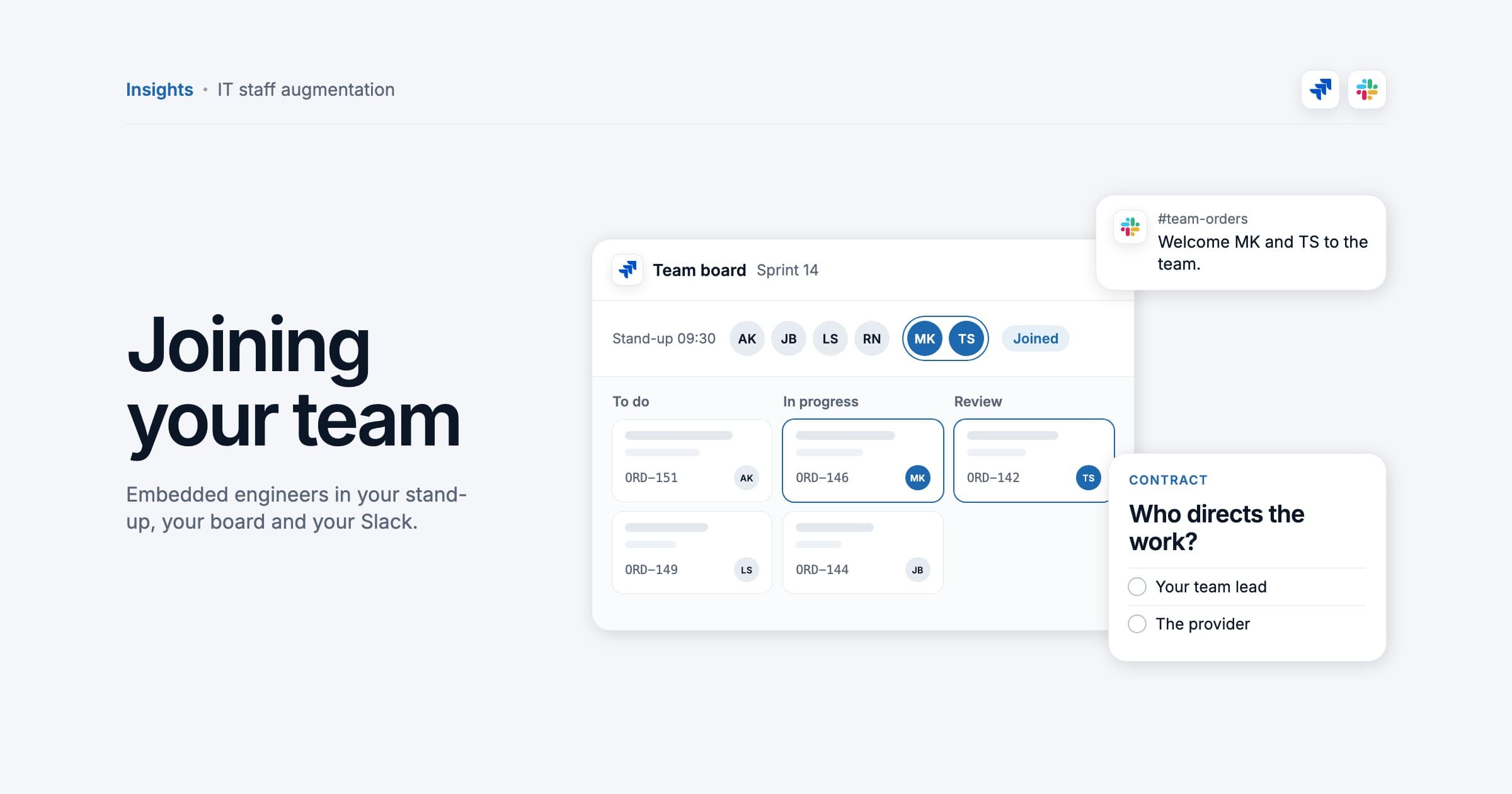
For an engineering team the practical tests are simple. Who assigns the work: your product owner or the provider's lead? Who sets the hours and approves holidays? Does the engineer sit in your one-to-ones and performance talks? Does your tech lead review their code and tell them to redo it? If the answers point to you, you are running labour leasing.
The AÜG rules you have to get right
If you choose leasing, or your setup amounts to it, these rules apply. The core has been stable since the 2017 reform. Two recent changes matter: since 1 January 2025 the leasing contract needs only text form instead of a wet signature (e.g. email, under the Fourth Bureaucracy Relief Act), and a December 2025 law on combating undeclared work adjusted the enforcement provisions.
- Licence. The agency needs a licence from the Bundesagentur für Arbeit (§ 1 Abs. 1 AÜG) and must state in the contract that it holds one (§ 12 AÜG). Ask for a copy and check its validity.
- Employment with the agency. The engineer must be employed by the agency. Leasing chains, where an agency passes on someone else's staff, are not allowed.
- Labelling and naming (Kennzeichnungspflicht). Before the engineer starts, the contract must expressly call the arrangement Arbeitnehmerüberlassung, and the engineer must be named with reference to that contract.
- 18-month maximum. The same engineer may work for the same client for at most 18 consecutive months. Earlier assignments count in full if the gap was three months or less, even through a different agency (§ 1 Abs. 1b AÜG). The cap is per engineer and per client company, not per team or site. A collective agreement in your sector can set a different limit.
- Equal treatment. The engineer is entitled to the essential working conditions, including pay, of your comparable staff (§ 8 AÜG). Only a collective agreement can deviate on pay, and only for the first nine months, or up to 15 months where sector supplements phase pay up from week six at the latest. You must tell the agency what your comparable staff earn.
- Works council. If you have one, it must be involved before a leased engineer starts, under § 99 BetrVG (§ 14 Abs. 3 AÜG).
A worked example with hypothetical dates: a leased backend engineer starts on 3 April 2026. Under the Bundesagentur's calculation method the assignment may run until the end of 2 October 2027. If the agency applies a collective agreement without sector supplements, equal pay applies from the tenth month of the assignment.
The 2022 ruling of the Court of Justice of the EU in TimePartner (C-311/21) requires collective agreements that pay agency workers less to compensate them in other ways; the Federal Labour Court applied this in 2023 (5 AZR 143/19) and upheld the main agency collective agreement. For senior engineers the pay gap is often small, but the paperwork still has to be right.
What happens when it goes wrong
If the agency has no licence, the contract was not labelled, the engineer was not named, or the 18 months are exceeded, the contracts are void (§ 9 AÜG). The law then deems the engineer to be your employee (§ 10 AÜG). Each breach can also be fined up to €30,000 per case (§ 16 AÜG).
Freelancers and Scheinselbstständigkeit in IT
For social security, § 7 SGB IV names two indicators of employment: working to instructions and integration into the client's organisation. The Deutsche Rentenversicherung (DRV) weighs all circumstances. Typical warning signs in IT are fixed hours and attendance, tickets assigned by your team, a company email and title that look like staff, one client for years, an hourly rate with no business risk, and no team or equipment of their own.
Agile work is not automatically employment. In a case that is now final, the Landessozialgericht Baden-Württemberg treated a developer in a Scrum team as self-employed (17 December 2021, L 8 BA 1374/20). He chose which work packages to pull into each sprint, received no instructions once a package was accepted, had specialist skills the employees lacked, ran his own company with other clients and charged a rate well above employee pay (CMS summary). The DRV still tends to read Scrum participation as a sign of integration, so the facts of each engagement decide.
The stakes are high. If the DRV finds employment, you owe employer and employee contributions retroactively, for up to four years, or 30 years where contributions were withheld intentionally (§ 25 SGB IV). Withholding contributions on purpose is also a criminal offence under § 266a StGB.
You can get certainty through a status determination by the DRV's Clearingstelle (§ 7a SGB IV). Since April 2022 it can decide before the engagement starts, on the basis of the contract and the planned way of working, and it can decide whether a freelancer placed through an agency is in fact employed by you, the end client. These additions currently expire on 30 June 2027 unless extended.
Nearshore and EU engineers
Engineers from other EU and EEA countries need no work permit in Germany. The cross-border questions sit with the provider, and the Bundesagentur's guidance answers most of them:
- EU or EEA agency leasing engineers to you in Germany: it needs a German AÜG licence, like a domestic agency.
- Agency outside the EU or EEA: leasing to Germany is prohibited without exception (§ 3 Abs. 2 AÜG). A nearshore provider in, say, Serbia or Ukraine can only work for you under a genuine project contract, or through an EU entity with a licence.
- Engineers who stay abroad and work only online: the Bundesagentur considers that the licence requirement does not apply if they never travel to Germany to work, while noting that no supreme court has ruled on it yet. If they also work on site in Germany, it does apply.
- Data access: if an engineer outside the EU or EEA can see personal data in your systems, that is a transfer under Chapter V of the GDPR and needs an adequacy decision or standard contractual clauses.
Practicalities matter as much as law. Agree core overlap hours, and use the same tooling and rituals as your team. Hiring non-EU engineers to relocate as your own employees is a separate route through residence law, such as the EU Blue Card.
Onboarding embedded engineers so they ship in week one
An engineer who spends week one waiting for access is expensive. A good plan aims for a merged pull request within three days and a small feature owned end to end by the end of week one.
- Five working days before: contract signed in the right form, engineer named, accounts requested (SSO, Git, CI, ticketing, chat, read-only cloud console), and a data processing agreement in place with the provider if personal data is in reach (Article 28 GDPR).
- Two days before: a development environment that builds and runs with one command, a written architecture overview of a page or two, and a scoped starter ticket with clear acceptance criteria.
- Day one: a one-hour architecture walkthrough, a buddy from the team, the local build running by lunchtime, and a first pairing session on the starter ticket.
- Days two and three: the starter ticket through code review and merged, plus a first look at the deployment pipeline.
- End of week one: a small feature owned end to end and a short retro: what slowed you down, what is missing from the docs.
Checklist before an external engineer starts
IT staff augmentation in Germany: pre-start checklist
- Decide honestly who will direct the engineer day to day, and choose the model that fits that answer.
- For leasing: copy of the agency's AÜG licence checked, contract in text form expressly labelled as Arbeitnehmerüberlassung, engineer named before the first day.
- For leasing: comparable staff's pay and conditions given to the agency, and the 18-month end date in your calendar (including earlier assignments with gaps of three months or less).
- For a Werkvertrag: a defined result, acceptance criteria, the provider's own lead, and no direct instructions from your team to its engineers.
- For freelancers: evidence of an independent business, outcome-based work packages, and a status determination under § 7a SGB IV for long or embedded engagements.
- Works council informed, and its consent obtained for leased engineers.
- For engineers outside the EU or EEA: no leasing, a genuine project contract, and GDPR transfer safeguards for any personal data access.
- Accounts, environment, starter ticket and buddy ready before day one.
- A review date set to check that practice still matches the contract.
When the setup is unusual, such as engineers working across borders, a freelancer embedded for more than a year, or a mix of models in one squad, ask an employment lawyer before the start rather than after an audit.
How we can help
Bespoke IT places senior engineers, vetted by the people who build our own products, into teams across Germany, Austria and Switzerland. We will tell you which contract model fits the way you want to work, and why. See IT staff augmentation or tell us who you need.
Have a question about your own setup?
Ask our AI coworker. It answers in seconds and a person from our team follows up.

Bespoke One Coworker. AI assistant. Answers in seconds, estimate in three minutes.